
Generate Accurate OpenAI RAG Citations & Format AI Responses
Streamlines OpenAI RAG output generation, reducing manual citation formatting and verification by up to 70% and ensuring transparent, trustworthy AI responses.
OpenAI Assistants can sometimes generate unverified or poorly formatted responses, making it challenging to trust them for critical information. This workflow ensures all AI-generated content from your OpenAI RAG assistants includes dynamic, verifiable citations from your vector store, allowing for precise output formatting in Markdown or HTML.


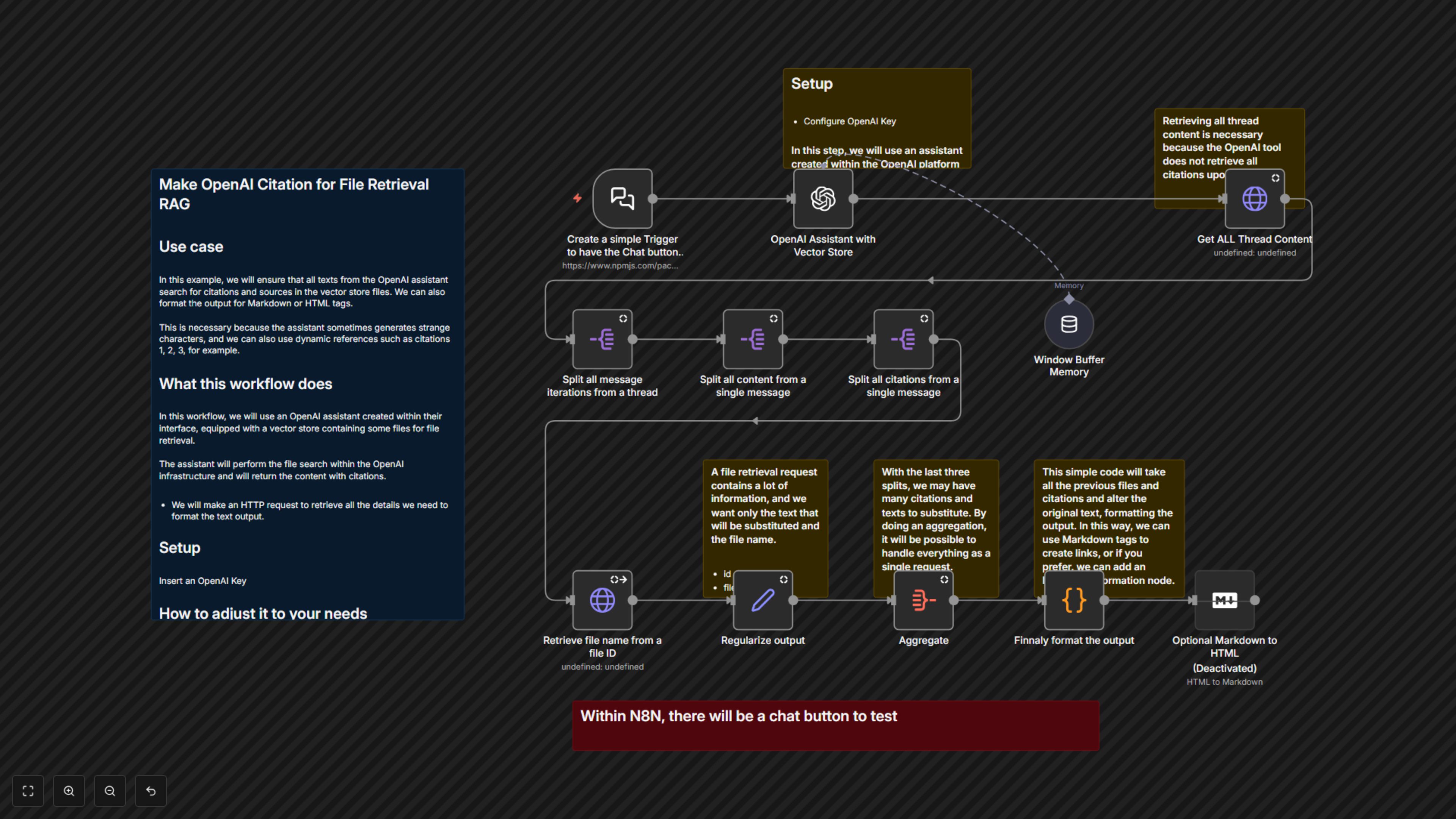

Documentation
Enhance OpenAI RAG with Dynamic Citations
This n8n workflow addresses the challenge of verifying and properly formatting outputs from OpenAI's Retrieval-Augmented Generation (RAG) assistants. It automates the extraction of source citations from your vector store, integrating them directly into the AI-generated text, and offers flexible formatting options.
Key Features
- Automated Citation Extraction: Automatically pulls citation details from OpenAI Assistant API responses, ensuring every piece of information is traceable to its source.
- Dynamic Reference Generation: Replaces placeholder citations in AI output with dynamically generated, readable references (e.g., _(filename)_).
- Flexible Output Formatting: Customize final output to include Markdown links or convert to HTML for seamless integration into various platforms.
- Enhanced AI Trustworthiness: Improves the reliability and transparency of your OpenAI RAG assistant's responses, making them suitable for critical applications.
- Simplified Integration: Provides a chat trigger for easy interaction and testing directly within n8n.
How It Works
This workflow starts with an n8n chat trigger, feeding user queries to an OpenAI Assistant configured with a vector store for file retrieval. After the assistant generates a response, the workflow makes a direct HTTP request to the OpenAI API to retrieve all thread messages and their detailed content, including citations (which the standard OpenAI node might not fully expose). It then meticulously splits, regularizes, and aggregates this data to match citation placeholders with their corresponding file names. Finally, a code node intelligently replaces these placeholders in the original AI output, followed by an optional Markdown to HTML conversion for presentation.