
Ecommerce Product Demand Forecasting Automation
Reduce manual demand forecasting effort by 70% with automated weekly product sales predictions.
Most ecommerce teams spend hours exporting reports and guessing next month’s demand product by product. This workflow automatically pulls recent order history, aggregates sales by month, and generates a simple forecast for next month per SKU. The results are written into a central report so planners can focus on decisions, not spreadsheets. The outcome is faster planning, fewer stock surprises, and a clearer picture of upcoming demand.



Documentation
Description
This automation delivers a lightweight demand forecasting layer on top of your ecommerce sales data. It runs on a weekly schedule, summarizes historical sales per product, and uses a simple rule-based forecasting model to estimate next month’s volume. Forecasts and identifiers are stored in a reporting sheet, giving the operations team a single source of truth for product-level planning and replenishment decisions.
Workflow Steps
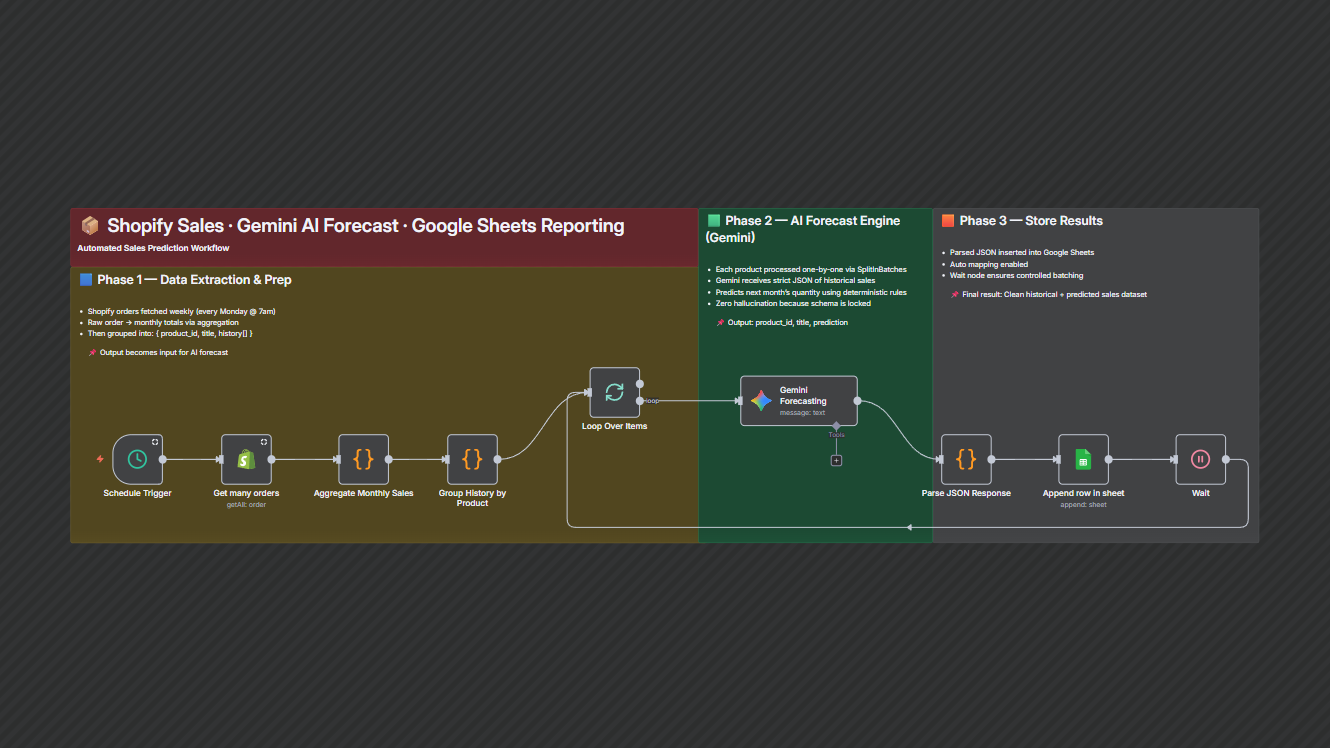
- Run on Weekly ScheduleThe workflow triggers automatically once a week (e.g., Monday at 7 AM) to refresh forecasts.
- Fetch Recent OrdersIt retrieves recent store orders and exposes each order’s line items for downstream processing.
- Aggregate Monthly Sales per ProductOrders are transformed into monthly totals, calculating how many units of each product were sold per month.
- Group Sales History by ProductFor each product, the workflow builds a compact history with product ID, title, and month-by-month totals.
- Generate Next-Month Forecast per ProductEach product’s history is sent to an AI forecasting step that applies simple logic: use last month if only one data point exists, or average the last two months when more history is available.
- Parse and Validate AI OutputThe returned forecast is parsed as strict JSON, and any invalid responses are safely handled.
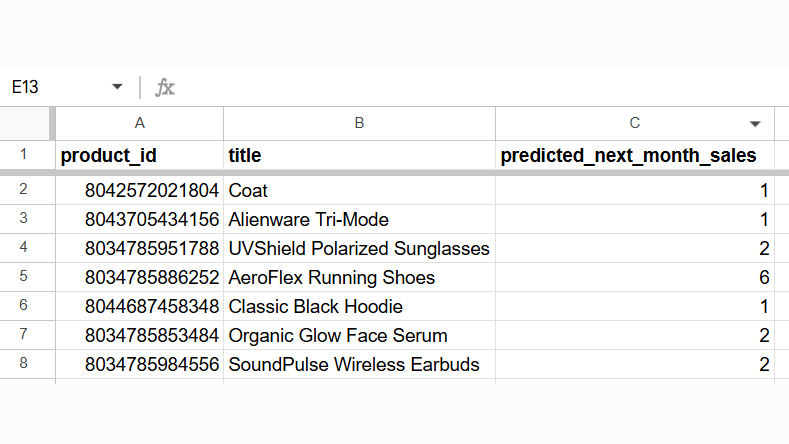
- Append Forecasts to Reporting SheetFinal product forecasts (ID, name, predicted quantity) are appended as new rows into a central spreadsheet so the team can track trends over time.
- Loop Until All Products Are ProcessedA loop and wait mechanism ensure every product is processed in batches without overwhelming APIs.
Key Benefits
- Faster Forecast CyclesRemoves repetitive export-and-Excel work so planners get an updated view each week with no manual effort.
- Simple, Transparent Forecasting LogicUses a clear, rule-based method (last month or two-month average) that’s easy for business users to understand and trust.
- Better Inventory Planning VisibilityCentralized forecasts per product help reduce stockouts and overstock by giving teams an early signal on expected demand.