
Automate Google SERP Data Collection for SEO Analysis
Collect comprehensive Google SERP data for thousands of keywords in minutes, reducing manual data collection time by over 90% and improving SEO analysis accuracy.
Manually tracking Google search rankings and competitor positions is a time-consuming and error-prone process. This workflow automates the extraction of comprehensive Google SERP data for specific keywords, providing accurate insights for SEO analysis and strategic decision-making.

Documentation
Automate Google SERP Data Collection for SEO Research
Tracking search engine rankings and analyzing competitor performance is crucial for effective SEO, but manual data collection is time-consuming and prone to errors. This workflow streamlines your SEO research by automatically extracting comprehensive Google Search Engine Results Page (SERP) data for any list of keywords, delivering actionable insights directly to your database.
Key Features
- Automated extraction of organic search results, paid advertisements, and "People Also Ask" sections.
- Precise assignment of organic search result positions (1-10) for accurate ranking analysis.
- Flexible keyword input: integrate with your existing databases (e.g., Airtable) or define keywords directly within the workflow.
- Streamlined data output to your preferred analytics or reporting database.
How It Works
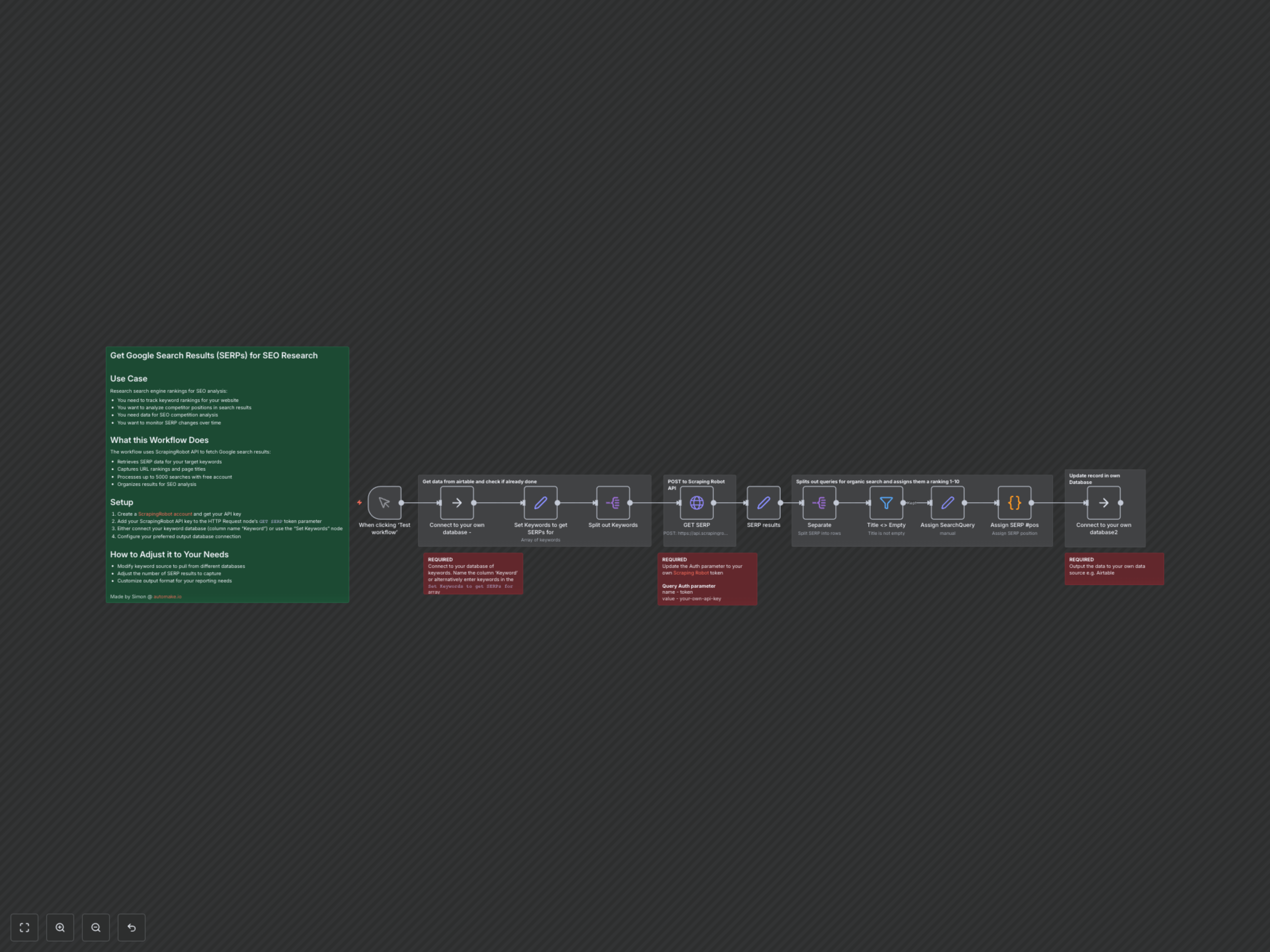
1. Keyword Input: The workflow begins by taking a list of keywords, either from a pre-defined array within the workflow or by connecting to your external keyword database. 2. SERP Retrieval: For each keyword, an HTTP POST request is sent to the ScrapingRobot API, leveraging its GoogleScraper module to perform a real-time Google search. 3. Data Extraction: The raw JSON response from ScrapingRobot is processed to meticulously extract key SERP components, including organic search results (title, URL), paid advertisements, and common questions from the "People Also Ask" section. 4. Ranking Assignment: Organic search results are then isolated, filtered for valid titles, and a custom JavaScript code node assigns an accurate numerical position (1-10) to each result based on its ranking for that specific keyword. 5. Database Integration: Finally, the structured and enriched SERP data, complete with assigned positions, is routed to your designated output database, ready for in-depth SEO analysis, reporting, and tracking.