
Get Instant, Personalized Movie Recommendations with AI Chatbot
Deliver personalized movie recommendations in seconds, eliminating manual search efforts and boosting user engagement.
Finding accurate, personalized movie recommendations can be time-consuming and frustrating, often leading to generic suggestions. This n8n workflow leverages AI to build a RAG chatbot, instantly delivering highly relevant movie recommendations based on user preferences.



Documentation
Building an AI-Powered Movie Recommender Chatbot
This comprehensive n8n workflow enables you to build an intelligent RAG (Retrieval-Augmented Generation) chatbot for highly personalized movie recommendations. It seamlessly integrates movie data, OpenAI's language models, and Qdrant's vector search capabilities to deliver accurate, context-aware suggestions.
Key Features
- Automates the ingestion of movie datasets, converting descriptions into vector embeddings for efficient search.
- Leverages Qdrant as a robust vector database to store and retrieve movie information based on semantic similarity.
- Incorporates OpenAI's advanced language models (GPT-4o-mini) for natural language understanding and conversational AI.
- Utilizes a RAG architecture to ground recommendations in factual data, reducing hallucinations and improving accuracy.
- Provides a user-friendly chat interface for instant, tailored movie suggestions.
How It Works
The workflow operates in two main phases: data ingestion and live recommendation.
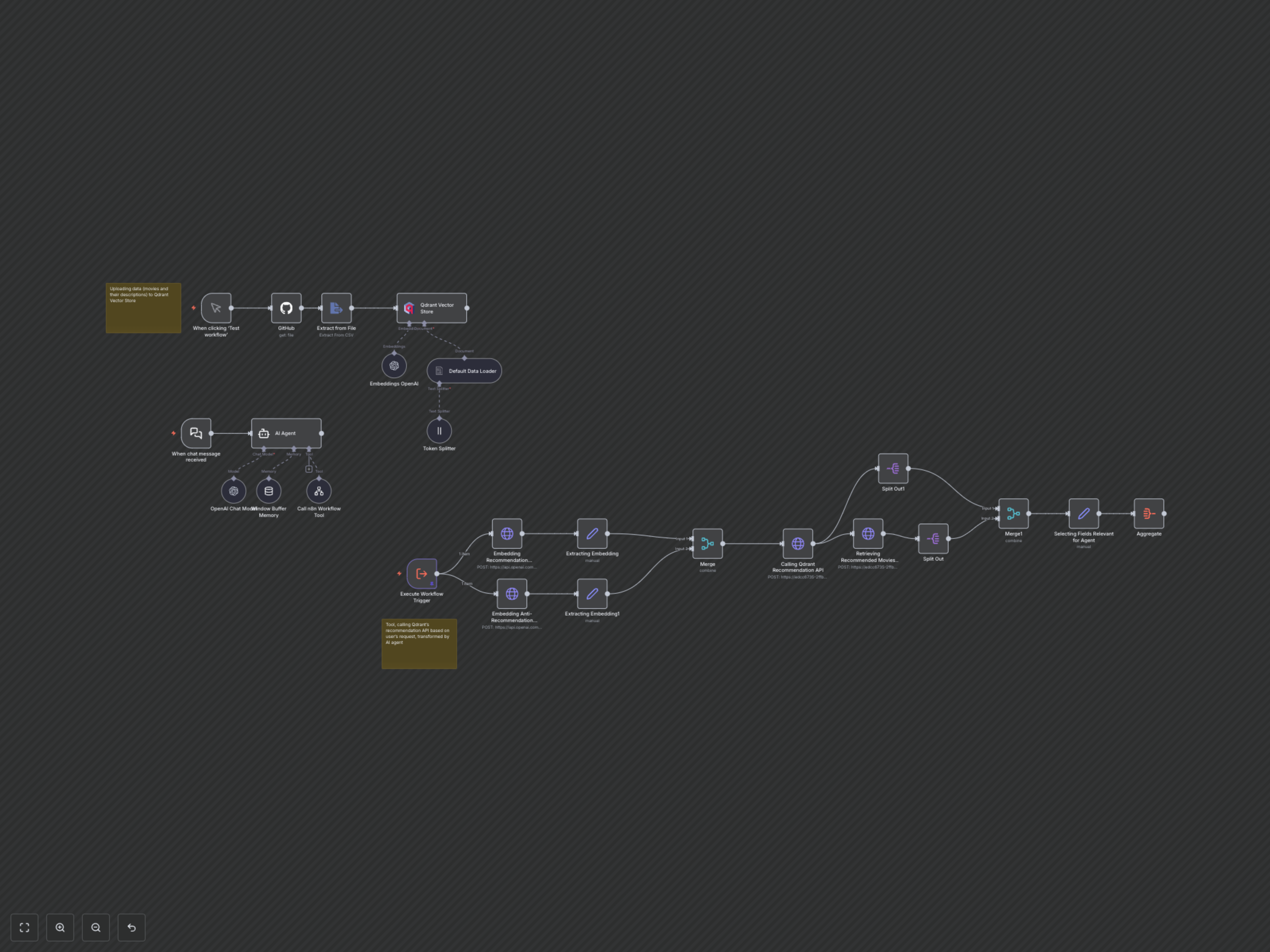
Data Ingestion: A manual trigger initiates fetching a movie dataset from GitHub. Movie descriptions are extracted, transformed into vector embeddings using OpenAI, and stored along with metadata (movie name, year, description) in your Qdrant vector store. This process populates the knowledge base.
Live Recommendation Chatbot: When a chat message is received, an n8n AI Agent (powered by OpenAI and conversation memory) interprets the user's request. It calls an internal 'movie_recommender' tool, which is a sub-workflow designed to interact with Qdrant. This tool converts the user's positive and negative movie preferences into embeddings, queries Qdrant for similar movies using its recommendation API, retrieves their metadata, and returns the top 3 results to the AI Agent. The agent then crafts a conversational response with the recommended movies.