
Build Persistent AI Agents with Supabase Memory & RAG
Empower AI agents to make more informed decisions by retaining context and knowledge across interactions, reducing context-switching errors by up to 60% and speeding up agent development.
Developing AI agents that remember past interactions, manage tasks, and leverage a dynamic knowledge base is complex and often leads to stateless, forgetful automations. This workflow provides a robust framework for building persistent AI agents using n8n, LangChain, OpenAI, and Supabase, enabling intelligent state management, RAG capabilities, and continuous learning.



Documentation
Build Intelligent, Persistent AI Agents
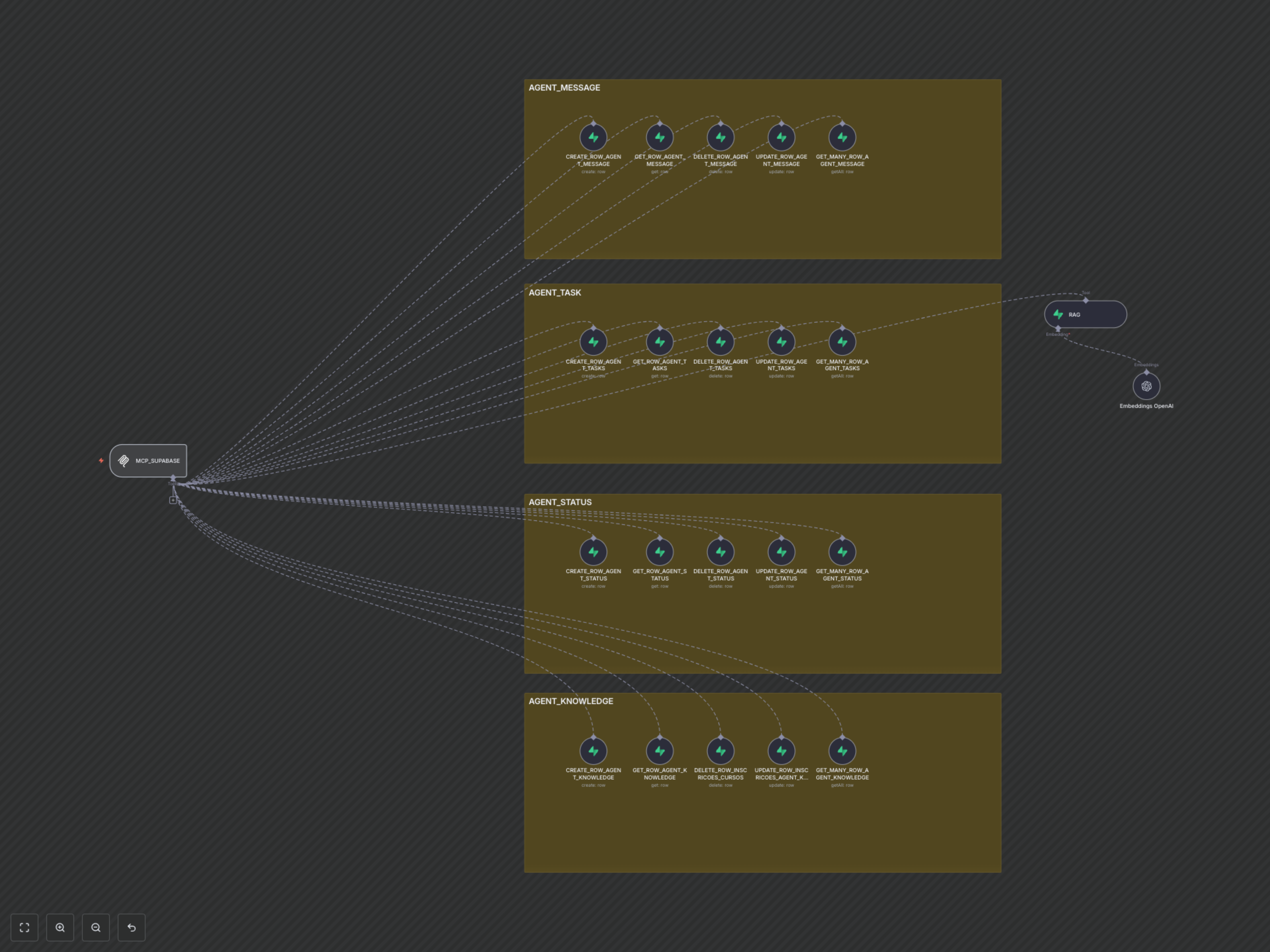
This n8n workflow provides a comprehensive foundation for creating advanced AI agents capable of remembering past interactions, managing tasks, tracking status, and utilizing a dynamic knowledge base. It integrates n8n's automation power with LangChain's AI orchestration, OpenAI's embeddings, and Supabase for robust, persistent data storage.
Key Features
- Persistent Agent Memory: Store and retrieve agent messages and interactions using Supabase to maintain context across sessions.
- Dynamic Task Management: Create, update, and track agent tasks in real-time, allowing agents to manage complex processes.
- Real-time Status Tracking: Monitor and update agent operational status, providing transparency and control.
- Knowledge-Augmented Generation (RAG): Empower agents with a live knowledge base stored in Supabase, retrieved and enhanced via OpenAI embeddings for intelligent, context-aware responses.
- Scalable Data Storage: Leverage Supabase's powerful database for reliable and scalable persistence of all agent data.
How It Works
The workflow is triggered by the MCP_SUPABASE node, acting as the central orchestrator for the AI agent. It utilizes a suite of Supabase nodes to perform CRUD (Create, Read, Update, Delete) operations on dedicated tables for agent_messages, agent_tasks, agent_status, and agent_knowledge. For advanced intelligence, the RAG (Retrieval Augmented Generation) node connects to a Supabase documents table, using OpenAI embeddings to retrieve relevant information based on current interactions. This allows the agent to "remember interactions and consult system instructions, while also storing what it learns," providing a powerful, adaptive, and stateful AI solution.