
Analyze Trustpilot Reviews & Uncover Key Customer Insights
Generate comprehensive customer insights and sentiment analysis from thousands of reviews in minutes, reducing manual analysis time by over 90%.


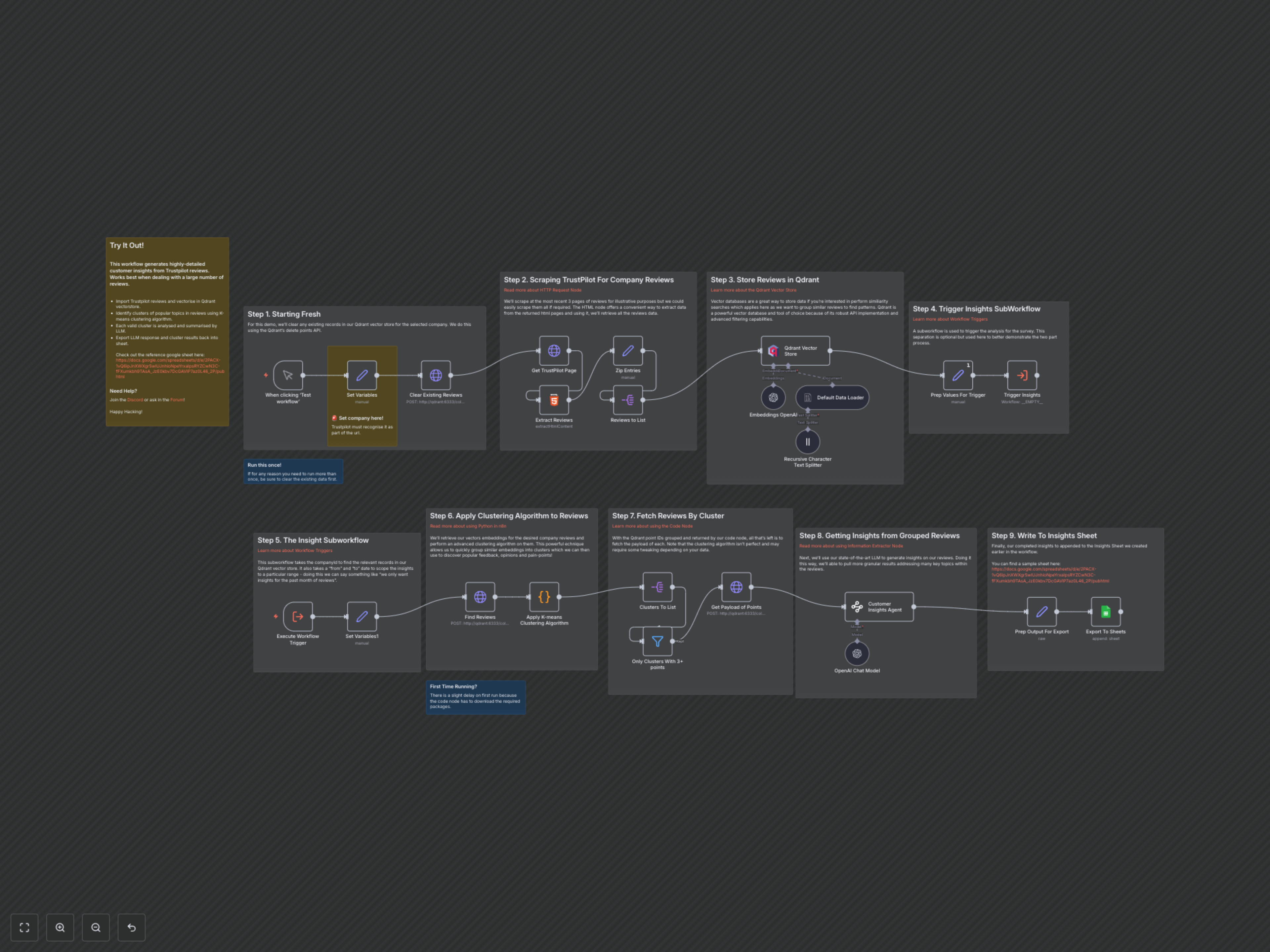
Manually analyzing Trustpilot reviews for trends and sentiment is time-consuming and error-prone, leading to missed opportunities. This workflow automates the extraction, vectorization, and AI-powered clustering of Trustpilot reviews to generate clear, actionable customer insights and sentiment analysis.
Trustpilot Review Insight Generator
This n8n workflow automates the entire process of collecting customer reviews from Trustpilot, processing them with advanced AI, and extracting actionable insights. It helps businesses understand customer sentiment, identify common feedback themes, and discover areas for improvement quickly and efficiently.
Key Features
- Automatically scrapes the latest reviews from any specified Trustpilot company page.
- Leverages vector embeddings (OpenAI) and Qdrant to store and enable advanced similarity searches on review data.
- Applies K-means clustering to automatically group similar reviews, uncovering popular feedback topics and pain points.
- Utilizes a powerful LLM (OpenAI Chat Model) to summarize clustered reviews, determine sentiment, and suggest improvements.
- Exports all generated insights, sentiment, and raw review data directly to Google Sheets for easy reporting and sharing.
How It Works
This workflow operates in two distinct phases: an initial data ingestion and vectorization process, followed by an insight generation subworkflow.
Phase 1: Data Ingestion and Vectorization
Upon manual trigger, the workflow first sets the target company ID. It then clears any existing records for this company in the Qdrant vector store to ensure a fresh start. Next, it scrapes the most recent reviews from the specified Trustpilot page using HTTP Requests and an HTML node to extract granular review data. This raw data is then structured, converted into vector embeddings using OpenAI, and finally stored in your Qdrant vector database, preparing it for advanced analysis.
Phase 2: Insight Generation (Subworkflow)
Once reviews are stored, a subworkflow is triggered. This subworkflow retrieves the relevant review vectors for a specified date range from Qdrant. It then applies a K-means clustering algorithm via a Python Code node to group similar reviews into clusters, identifying common themes and feedback patterns. For each significant cluster (those with 3 or more reviews), an OpenAI Chat Model (via Langchain's Information Extractor) analyzes the grouped reviews to generate a summary, overall sentiment (e.g., positive, negative), and actionable suggested improvements. Finally, these valuable insights, along with relevant review data, are exported to your designated Google Sheet.