

Sarah's Friday Afternoon Ritual (And Why It Cost Her Everything)
Every Friday at 2 PM, Sarah would brew her third coffee and open her laptop with a small sigh.
The weekly marketing report. The one her CEO needed Monday morning to make decisions.
Six hours of pulling data from Facebook Ads, Google Analytics, Mailchimp, and Salesforce. Copy, paste, fix the formulas someone broke, generate charts, write the summary. Send.
For 18 months, she never questioned it.
"That's just how we do reports," her manager said when she started. So every Friday disappeared into spreadsheet land while her real ideas—the email campaign redesign, the customer segmentation project, the content strategy she dreamed about—sat on her "someday" list.
Then someone asked a simple question:
"What if Sarah spent those six hours on something else?"
The math was uncomfortable:
Her time cost the company $52/hour. Six hours weekly = $16,224 annually just in direct salary costs.
But the real shock came when they calculated what she wasn't doing with those 312 hours:
That email nurture campaign she kept postponing? Could generate an estimated $45,000 in additional revenue.
The customer segmentation that would improve retention by 12%? Worth roughly $38,000.
The content strategy overhaul? Lead quality improvement worth $28,000.
Sarah's "simple" Friday report was actually costing $127,000 in lost opportunity.
A $129 automation workflow now handles that report in four minutes. While Sarah sleeps.
She finally launched those projects that lived in her head.
Last quarter, her initiatives drove $67,000 in new revenue.
This story isn't unique. It's happening in your business right now. You just can't see it because nobody sends invoices for "copied data between systems" or submits expense reports for "updated CRM manually."
Let's make the invisible visible.
Why Smart People Keep Doing Expensive Things Manually
Here's the thing about manual processes: they don't feel expensive.
There's no moment where you think, "I'm about to waste $400 of company resources on this task."
You just... do it. Because it needs doing. Because "that's how we've always done it." Because automating feels complicated and your to-do list is already overwhelming.
But here's what we've learned from talking to hundreds of business owners:
The cost of manual work isn't just the time it takes. It's everything that doesn't happen because you're stuck doing repetitive tasks that could run themselves.
Let's talk about what that actually looks like.
The Five Costs You Can't See (Until Someone Points Them Out)
💡 The Projects That Never Launch

Meet Marcus, CEO of a 35-person SaaS company
His sales team spent 90 minutes daily updating their CRM. Call notes, email logs, next steps—all manual entry.
"Just part of the job," they said.
Then Marcus did the math: His top sales rep spent 7.5 hours weekly on data entry.
That's 390 hours annually. Nearly ten full work weeks typing instead of selling.
The kicker?
With those 390 hours, that rep could have conducted 195 additional discovery calls. At their 25% close rate, that's 49 deals they never even attempted. Average deal size: $15,000.
The data entry wasn't costing $28,000 in salary.
It was costing $735,000 in deals that never happened.
They automated the CRM updates. The rep's revenue jumped 44% the following quarter.
Not because they worked harder. Because they finally had time to actually sell.
Meet Jennifer, HR Director at a growing services firm
She spent eight hours onboarding each new hire. Paperwork, system access, equipment orders, training schedules. For four new hires monthly, that was 32 hours—a full work week—on administrative tasks.
The employee retention program she'd been designing for 14 months? Still sitting in a Google Doc.
Here's what that delay cost:
Their turnover rate: 34% of 75 employees = 26 people annually leaving.
Replacement cost per person: $45,000 (recruiting, training, lost productivity).
Annual turnover cost: $1.17 million
If her retention program could reduce turnover by just 10 percentage points—a conservative estimate—that's $450,000 in annual savings.
She had the expertise. She just didn't have the time.
They automated onboarding. She built the retention program. Turnover dropped from 34% to 24% in eight months.
The savings? $450,000 annually.
The automation cost? $299.
⚠️ The Errors That Cascade
Meet David, who runs a busy e-commerce store
He sold on Shopify, Amazon, and eBay. Every platform needed manual inventory updates after each sale.
With 340 orders weekly, it was manageable. Tedious, but manageable.
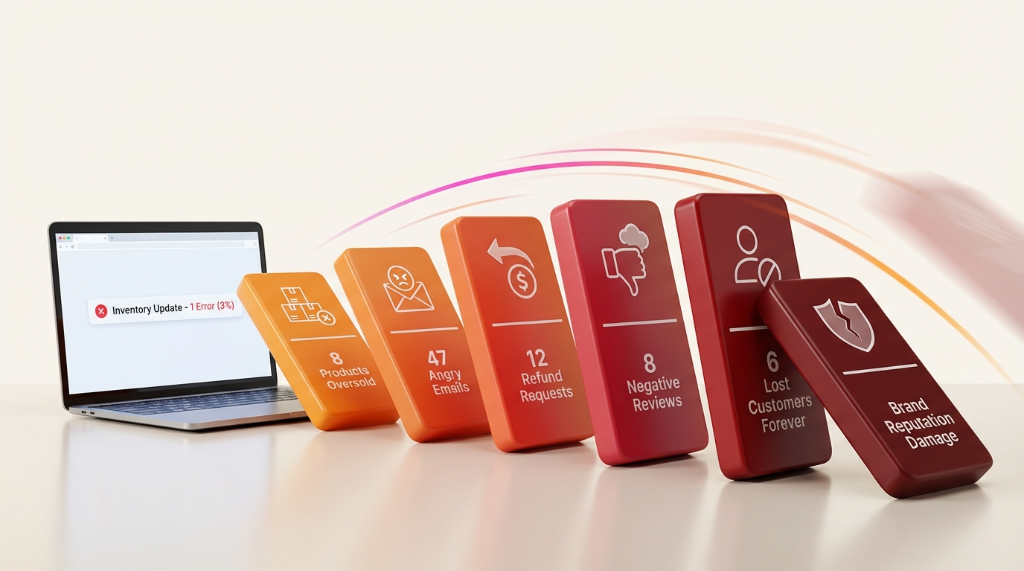
Except for the 3% error rate.
Ten mistakes weekly doesn't sound terrible until you see what happens next:
Week 1: Manual update mistakes → 8 products oversold

Week 2: 47 angry customer emails
        12 refund requests
        8 negative reviews posted

Week 3: Customer service scrambling for 15 hours
        Brand reputation damaged
        6 customers never buy again
Annual cost of those "small" mistakes:
- Customer service time: $9,360
- Refunds: $2,400
- Lost customer lifetime value: $18,000
Total: $29,760 in measurable damage
Plus the incalculable cost of negative reviews when you're trying to grow.
The automation solution cost $149.
Setup time: 2 hours.
No oversells in six months since going live. Review rating climbed from 3.8 to 4.7 stars.
🔄 The Context-Switching Tax
Meet Rachel, Customer Success Manager
A customer asks a simple question in Slack: "Can you check the status of our last support ticket?"
Seems straightforward. But here's Rachel's actual process:
- Switch to Salesforce → Find account
- Switch to billing system → Check subscription tier
- Switch to Zendesk → Pull ticket history
- Switch to analytics → Review product usage
- Switch to email → Find past conversations
- Switch to Google Drive → Locate documentation
- Switch back to Slack → Wait, what was the question again?
Seven context switches for one answer.
Research shows every switch costs 23 minutes of lost focus. That's 161 minutes of disrupted productivity to deliver eight minutes of actual help.
Rachel handles 15 questions daily.
Her team of eight: 15 questions each = 120 daily questions.
At 161 minutes lost per question: 322 hours weekly vanish into app-switching.
At $45/hour: $753,480 annually disappearing into context-switching overhead.
They built a Slack bot that pulls data from all seven systems.
New process:
- Customer asks in Slack
- Rachel types:
/customer-info [company name] - Bot returns complete view in 3 seconds
- Rachel answers question (8 minutes total)
Time saved per question: 153 minutes
Annual productivity recapture: $715,000
Not from working harder. From eliminating the friction.
💔 The Talent You're Losing
Meet Elena, who owns a 40-person creative agency
She couldn't understand why her best account managers kept leaving after 18-24 months.
Great salary. Good culture. Interesting clients. What was she missing?
Then she read the exit interviews:
"I went to school for strategic marketing. I spend 65% of my time copying data between systems."
"I'm talented at solving problems. But I spend my days updating spreadsheets."
"I can do this job anywhere. I want to work somewhere that uses my actual skills."
The pattern was clear: She wasn't losing mediocre performers. She was losing the talented people who recognized their potential was being wasted.
Annual cost:
- 5 account managers lost yearly
- Replacement cost: 1.75× their $75,000 salary
- Total: $656,250 in turnover costs
But the invisible cost hurt more:
New hires watched the best people leave and thought, "If they're leaving, should I even stay?"
Morale death spiral.
She automated the busy work:
- Client reporting (6 hours → 20 minutes)
- Data synchronization across platforms
- Campaign performance compilation
- Status update generation
Results after 12 months:
Account manager turnover: 45% → 8%
Average tenure: 19 months → 38 months
Team morale score: 4.2/10 → 8.7/10
Annual savings: $109,000
Investment: $2,400
Her best people stopped job hunting. Started referring talented friends. The agency went from struggling to retain talent to having a waiting list.
Because talented people don't leave jobs.
They leave the soul-crushing busy work that makes them feel like highly-paid data entry clerks.
📚 The Training That Never Ends
Here's the scaling trap most businesses don't see:
Every manual process must be taught to every new employee.
When you're small, this feels manageable. Train someone once, they've got it.
But as you grow, the training burden multiplies while automation stays constant.
Meet Tom, Operations Manager at a 60-person logistics company
Their order fulfillment process documentation: 47 pages. (Seriously. Forty-seven pages.)
It covered checking inventory in System A, verifying payment in System B, creating shipping labels in System C, updating customer records in System D, notifying the warehouse in System E... plus 23 different exception scenarios and 14 "workarounds for when the system glitches."
Training time per new hire: 8 hours
At 30% annual growth, they hired nine people yearly.
Annual training cost for ONE manual process:
- Trainer time (senior person @ $75/hr): $5,400
- New hire time learning (@ $45/hr): $3,240
- Lost productivity during learning curve: $12,960
- Quarterly documentation updates: $1,800
Total: $23,400 annually to train one process
They had 18 manual processes requiring similar training.
Total training overhead: $421,200 every single year
After automation, their training documentation became:
"Orders process automatically when payment clears. Monitor the dashboard for exceptions—about 2% require manual review."
Training time: 15 minutes
Annual savings: $398,000
The insight:
Manual processes have training costs that scale with headcount.
Automated processes cost the same to train whether you have 10 employees or 1,000.
What's This Actually Costing You?
Let's get specific about your business.
We've analyzed hundreds of companies, and here's what we consistently find:
If You're Running a Small Business (10-50 Employees)
Typical weekly manual burden:
- Data entry and system updates: 15 hours
- Report generation: 8 hours
- Email follow-ups and admin: 12 hours
That's 35 hours weekly disappearing into manual processes.
At $50/hour average loaded cost, direct waste: $91,000 annually
But when you add:
- The strategic work not happening (opportunity cost)
- The errors requiring correction
- The training as you hire
- The good people considering leaving
Total hidden cost: $300,000-$450,000 annually
As a percentage of a typical $3M revenue business: 10-15%
You're giving a dime of every dollar to manual processes that create zero customer value.
If You're Mid-Market (50-200 Employees)
Typical weekly manual burden:
- Department reporting: 40 hours
- Cross-system data synchronization: 35 hours
- Customer communication routing: 28 hours
- Administrative workflows: 45 hours
That's 148 hours weekly vanishing.
Direct annual waste: $462,000
With hidden costs: $2-3 million annually
For a $20M revenue business, that's 10-15% of revenue funding manual overhead instead of growth.
The Automation ROI Nobody Talks About
Here's what every CFO should know:
Most automation investments pay for themselves in days, not months.
Let's look at the three most common processes companies automate first:
Process #1: Lead Capture & CRM Entry
Before automation:
- Sales rep spends 8 minutes per lead doing data entry
- 120 leads monthly = 16 hours monthly
- Annual cost: $8,640 in direct time
- Plus opportunity cost of sales time not selling: $27,000
After automation:
- Lead fills form → automatically enriched with company data → added to CRM → assigned to right rep → initial email sent
- Sales rep time: 0 minutes
Automation cost: $89 workflow + 2 hours setup
Annual savings: $27,000
ROI: 15,000%
Payback period: 3.5 days
Process #2: Weekly Reporting
Before automation:
- Manager spends 6 hours weekly compiling data
- Annual time: 312 hours
- Direct cost: $18,096
- Plus opportunity cost of strategic work not done: $31,000
After automation:
- Dashboard updates automatically from all sources
- Manager reviews in 30 minutes weekly
Automation cost: $199 workflow + 4 hours setup
Annual savings: $31,000
ROI: 7,700%
Payback period: 4 days
Process #3: Customer Onboarding
Before automation:
- 4.5 hours per customer (document creation, system setup, emails, scheduling)
- 12 customers monthly = 54 hours monthly
- Annual cost: $31,104
- Plus impact of slow onboarding on satisfaction: $99,000
After automation:
- Contract signed → full onboarding cascade triggers automatically
- Team time per customer: 45 minutes (just reviewing, not doing)
Automation cost: $299 bundle + 8 hours setup
Annual savings: $99,000
ROI: 14,000%
Payback period: 2.8 days
The pattern is clear:
Automation typically pays for itself within the first week.
Then keeps saving money forever.

The Five Processes to Automate First
Based on working with hundreds of businesses, these deliver the fastest ROI:
🎯 #1: Lead Capture & CRM Updates
Why it's expensive: Sales time is premium time.
Real transformation:
Before: Sales team manually entering leads, Googling companies, updating CRM fields
After: Form submitted → Lead enriched automatically with company size, industry, tech stack, funding status → CRM contact created → Assigned to right rep → Personalized email sent → Follow-up sequence scheduled
Common results:
- Time saved: 10-15 hours per rep weekly
- Lead response time: Hours → Minutes
- Data quality: Inconsistent → Comprehensive
📊 #2: Report Generation
Why it's expensive: People capable of analysis waste time gathering data.
Real transformation:
Before: Managers spending Friday afternoons pulling data from 5-8 tools, fighting with formulas, formatting charts
After: Automated dashboards updating in real-time, alerts for anomalies, scheduled reports auto-generated and emailed
Common results:
- Time saved: 5-10 hours weekly per manager
- Data freshness: Days old → Real-time
- Decision speed: Weekly → Daily
🚀 #3: Customer Onboarding
Why it's expensive: Manual coordination = slow time-to-value = customers questioning their purchase.
Real transformation:
Before: Multiple emails back-and-forth, chasing documents, coordinating calendars, manually provisioning access
After: Contract signed → Documents auto-sent for e-signature → Systems auto-provisioned → Welcome sequence triggered → Training scheduled → Check-ins calendared
Common results:
- Onboarding time: 2 weeks → 2 days
- Customer satisfaction: +40%
- Early churn: -70%
💰 #4: Invoice Processing
Why it's expensive: High error rates create chaos.
Real transformation:
Before: Manual data entry from PDF invoices, matching to purchase orders, routing for approvals, chasing signatures
After: Invoice received → Data auto-extracted → Matched to PO → Routed to approver → Accounting entry created → Payment scheduled
Common results:
- Processing time: 12 minutes → 2 minutes per invoice
- Error rate: 3% → 0.2%
- Vendor relationship improvements
📧 #5: Email Follow-Up Sequences
Why it's expensive: Deals die from neglect, not objection.
Real transformation:
Before: Reps trying to manually remember who to follow up with, when, and what to say
After: Intelligent sequences personalized by industry, company size, and behavior. Automatically pauses if prospect engages. Alerts rep at perfect moment.
Common results:
- Follow-ups per lead: 1.2 → 6.8
- Response rate: 12% → 43%
- Deals "going cold": -75%
Start This Week (Your Action Plan)
You don't need to automate everything at once.
Just prove it works with one process.
Monday: Pick One Process
Choose something that:
- Frustrates you regularly
- Happens frequently
- Has clear, repetitive steps
- Everyone agrees is tedious
Quick decision guide:
If you're in Sales: Start with lead data entry
If you're in Marketing: Start with reporting
If you're in Operations: Start with order processing
If you're in Finance: Start with invoice handling
If you're in HR: Start with onboarding
Tuesday: See What It's Really Costing
Use our ROI calculator to get your specific numbers:
- Time spent weekly
- Annual cost (including hidden factors)
- What you could do with that time instead
This isn't theoretical. These are your actual dollars evaporating.
Wednesday: Find Your Solution
Browse workflows designed for your exact scenario.
Look for:
- ✅ Real customer reviews
- ✅ Before/after metrics
- ✅ Your industry examples
- ✅ Clear implementation steps
Need help choosing? Our AI recommender asks three questions and matches you perfectly.
Thursday: Get It Running
Two paths:
DIY Setup (4-6 hours):
- Download workflow
- Follow step-by-step guide
- Connect your tools
- Test and go live
Done-For-You (0 hours for you):
- Quick call to understand your setup
- We handle implementation
- You review and approve
- We train your team
Friday: Celebrate
By Friday afternoon, you'll have:
- ✅ Your first automation running
- ✅ Hours reclaimed this week
- ✅ Proof this actually works
- ✅ Template for the next one
What Happens Next
Here's what we see consistently after businesses automate their first process:
Week 1: Relief. "I can't believe we were doing this manually."
Month 1: Momentum. Team asks, "Can we automate this too?"
Quarter 1: Transformation. With reclaimed time, strategic projects finally happen.
Year 1: Competitive advantage. You're operating at 140% capacity with same headcount.
It all starts with one process this week.
The Choice You're Actually Making
Every week you continue doing things manually, you're choosing to:
- ❌ Spend $5,000-10,000 on work that could run itself
- ❌ Watch talented people spend 40% of their time on tasks they hate
- ❌ Make decisions on incomplete, outdated data
- ❌ Let strategic initiatives sit on the "someday" list
Or you can choose differently:
- ✅ Invest $89-599 in automation that pays for itself in days
- ✅ Free your team to do work that actually uses their skills
- ✅ Have real-time, accurate data for decisions
- ✅ Finally launch those projects that will move the needle
The companies thriving in 2026 aren't working harder.
They're automating smarter.
Take the First Step
🎯 Calculate What You're Losing
See exactly what manual processes cost—in real dollars, lost opportunities, and team frustration.
One Last Story
Remember Sarah from the beginning? The one spending six hours every Friday on reports?
That workflow now runs automatically at 4 PM every Friday.
She gets a Slack notification: "Your weekly report is ready." Takes two minutes to review. Sends to CEO.
What she does with those six reclaimed hours:
Redesigned the email nurture sequence. +$45,000 in revenue.
Built the customer segmentation system. +12% retention.
Launched the content strategy. +34% lead quality.
Her initiatives drove $67,000 in new revenue last quarter.
The automation cost: $129
Your turn.
What would you do with six extra hours weekly?
What strategic project has been sitting on your "someday" list?
What could your business achieve if your talented people spent their time on work that actually matters?
You don't have to wonder.
You can start this week.
Written by the Supern8n team—because we believe talented people deserve to spend their time on work that challenges them, not work that bores them to tears.
Stop funding manual processes. Start funding growth.