
Extract Global Swift Codes & Streamline Bank Data Collection
Automate the collection of all global Swift codes, reducing data acquisition time by 90% and maintaining a consistently updated bank data repository.
Manual collection of global bank Swift codes is a a tedious and error-prone process, hindering efficient financial operations. This workflow fully automates the extraction of comprehensive Swift code data from web pages, populating your database with accurate bank information for every country.

Documentation
Extract Global Swift Codes & Streamline Bank Data Collection
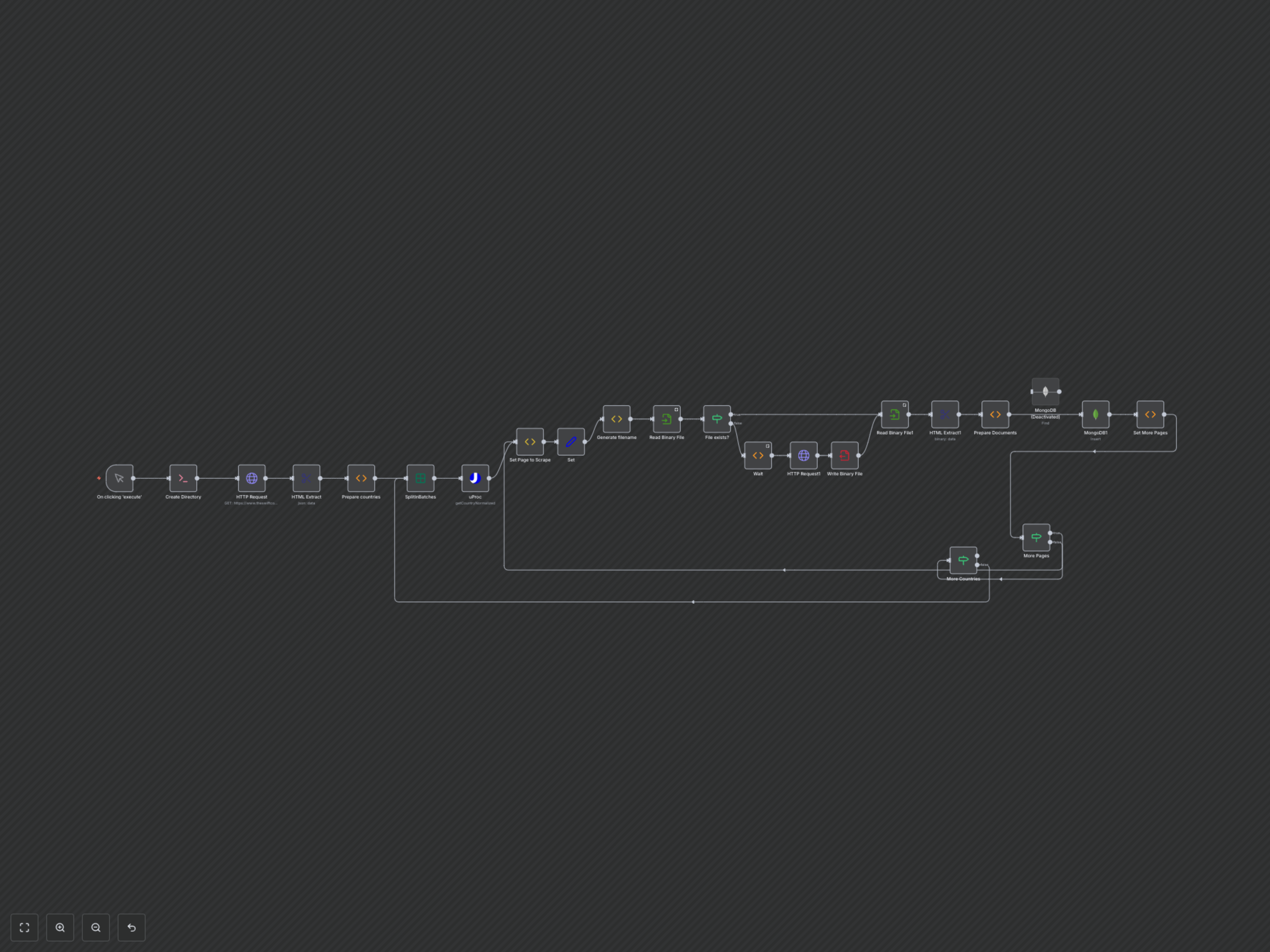
This powerful n8n workflow systematically scrapes bank Swift codes, names, cities, and branches from the theswiftcodes.com website. It handles country-level and page-level pagination, normalizes country data using uProc, and efficiently stores all extracted information into a MongoDB database. This ensures you maintain a comprehensive and up-to-date repository of global bank Swift codes without any manual effort.
Key Features
- Automated Web Scraping: Efficiently extracts bank Swift codes and associated details from a target website.
- Country Data Normalization: Utilizes uProc to standardize country names and ISO codes for consistency.
- Pagination Handling: Automatically navigates through multiple pages within each country to capture all available data.
- Robust Data Storage: Seamlessly inserts extracted and normalized data into a MongoDB database.
- Local Cache for Efficiency: Stores scraped HTML pages locally to prevent redundant HTTP requests and speed up re-runs.
How It Works
The workflow begins by creating a local directory for caching. It then retrieves a list of all countries from the target website's main browse page. Each country is processed individually. For each country, the workflow uses uProc to normalize the country name and obtain its ISO code. It then attempts to fetch the Swift code data for that country. To optimize performance and reduce server load, it first checks if the HTML content for the specific URL is already cached locally. If available, it reads from the cache; otherwise, it makes a new HTTP request, downloads the HTML, and saves it to the local cache. The workflow then extracts bank names, Swift codes, cities, and branches from the HTML. If there are multiple pages of Swift codes for a given country, the workflow automatically detects and navigates to the next page, repeating the extraction process. Finally, all extracted and normalized data is structured and inserted into a designated MongoDB collection, complete with creation and update timestamps. This process continues until all Swift codes across all countries and their respective pages have been collected.