
Automate OpenAI Citation Formatting for RAG Accuracy
Reduces manual citation formatting and verification time by up to 90%, delivering precise, source-backed content for enhanced reliability and trust.
Manual citation extraction and formatting from OpenAI assistants can be tedious, leading to inaccuracies and slowing content delivery. This workflow automates the retrieval and dynamic formatting of citations from your OpenAI vector store, ensuring every AI-generated response is precisely sourced and ready for immediate use.



Documentation
Automate OpenAI Citation Formatting for RAG Accuracy
AI assistants, while powerful, often struggle with precise citation generation and source attribution, leading to content that lacks credibility or requires extensive manual review. This n8n workflow resolves this by fully automating the retrieval and dynamic formatting of citations from OpenAI's vector store files, transforming raw AI output into professionally referenced content.
Key Features
- Dynamic Citation Retrieval: Automatically extracts all citation details and source file IDs from OpenAI Assistant threads, overcoming initial API output limitations.
- Intelligent Source Attribution: Retrieves original filenames for cited content, providing clear, human-readable references within the generated text.
- Customizable Output Formatting: Replaces raw citation tags with dynamic references like _(filename)_ and offers optional Markdown-to-HTML conversion for versatile use.
- Enhanced RAG Accuracy: Ensures every piece of information is traceable to its source in your vector store, boosting trust and reliability in AI-generated content.
How It Works
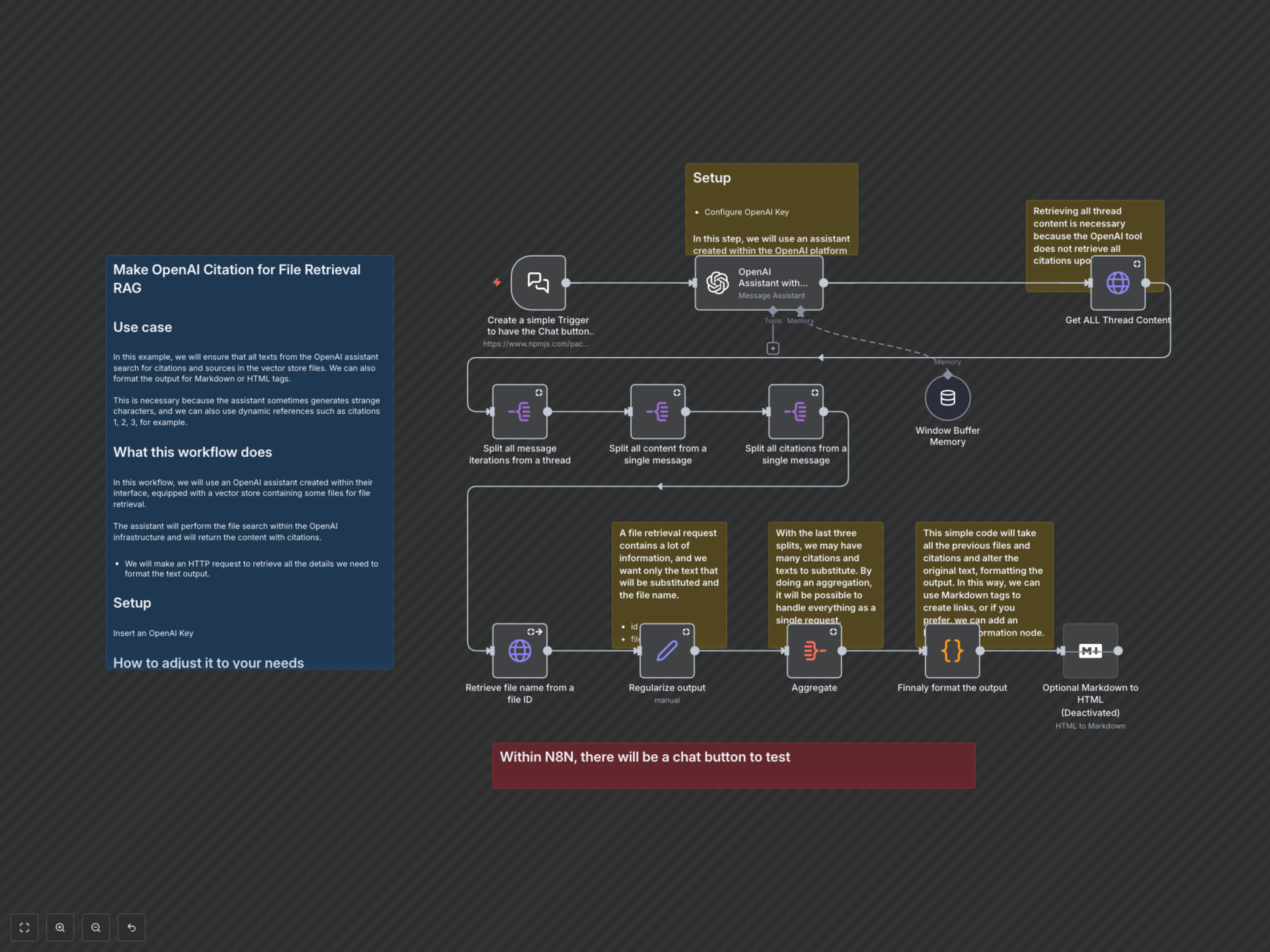
This workflow initiates via a simple chat trigger within n8n, feeding user prompts to an OpenAI Assistant configured with a vector store for file retrieval. After the assistant generates a response, the workflow proactively makes an HTTP request to OpenAI's API to fetch all thread messages and their associated citations, as the initial assistant output may be incomplete. It then meticulously splits this data to isolate individual messages, content, and citation annotations. For each citation, it retrieves the corresponding filename from your vector store via another OpenAI API call. All retrieved citation details (original text, file ID, filename) are then aggregated. Finally, a code node intelligently replaces the raw citation placeholders in the assistant's output with formatted, filename-based references, creating a highly accurate and professional response. An optional node can then convert this Markdown output into HTML for broader use.