
Automate Etsy Product Data Extraction with AI Insights
Automate Etsy product data extraction and AI-driven analysis, reducing data collection time by over 80% and enabling faster market trend identification.
Manual Etsy product data collection is slow and often blocked by anti-scraping measures, delaying market analysis. This workflow automates comprehensive Etsy data extraction using Bright Data and Google Gemini AI to deliver structured product insights efficiently.



Documentation
Automate Etsy Product Data Mining with AI
This n8n workflow is designed to effortlessly scrape product listings from Etsy, overcoming common web scraping challenges with Bright Data's Web Unlocker. It then harnesses the power of Google Gemini (or OpenAI) to intelligently extract and structure valuable product information, making it ready for analysis or further use.
Key Features
- **Automated Etsy Scraping:** Seamlessly extract product data from Etsy without manual intervention or IP blocking concerns using Bright Data's Web Unlocker.
- **AI-Powered Data Extraction:** Utilize Google Gemini (or OpenAI) to accurately parse and structure complex product details and paginate through search results.
- **Pagination Handling:** Automatically navigate and scrape multiple pages of Etsy search results to ensure comprehensive data collection.
- **Flexible Data Output:** Save extracted product information to disk as JSON files and push summaries via webhooks for immediate action.
- **Customizable Search Queries:** Easily adjust the Etsy search query to target specific products or categories.
How It Works
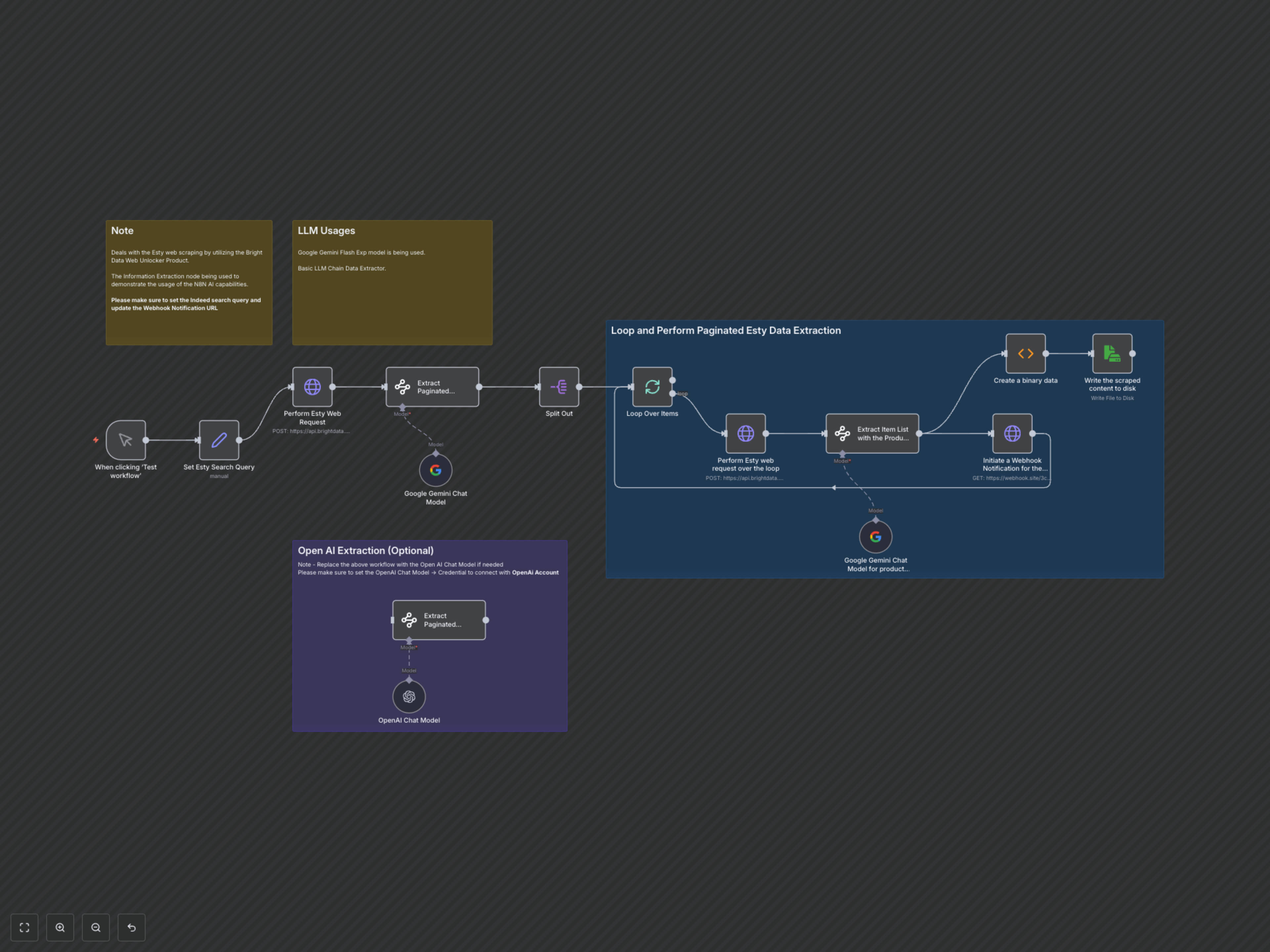
The workflow initiates with a predefined Etsy search URL. It uses Bright Data's Web Unlocker to perform a web request, intelligently bypassing anti-scraping measures. An AI Information Extractor (powered by Google Gemini by default) then identifies and extracts pagination links from the initial results. These links are processed in a loop, with each subsequent page scraped and its product details extracted using another AI Information Extractor. Finally, the structured product data is saved locally as JSON files, and a summary of the extracted data is sent to a webhook for real-time notifications.